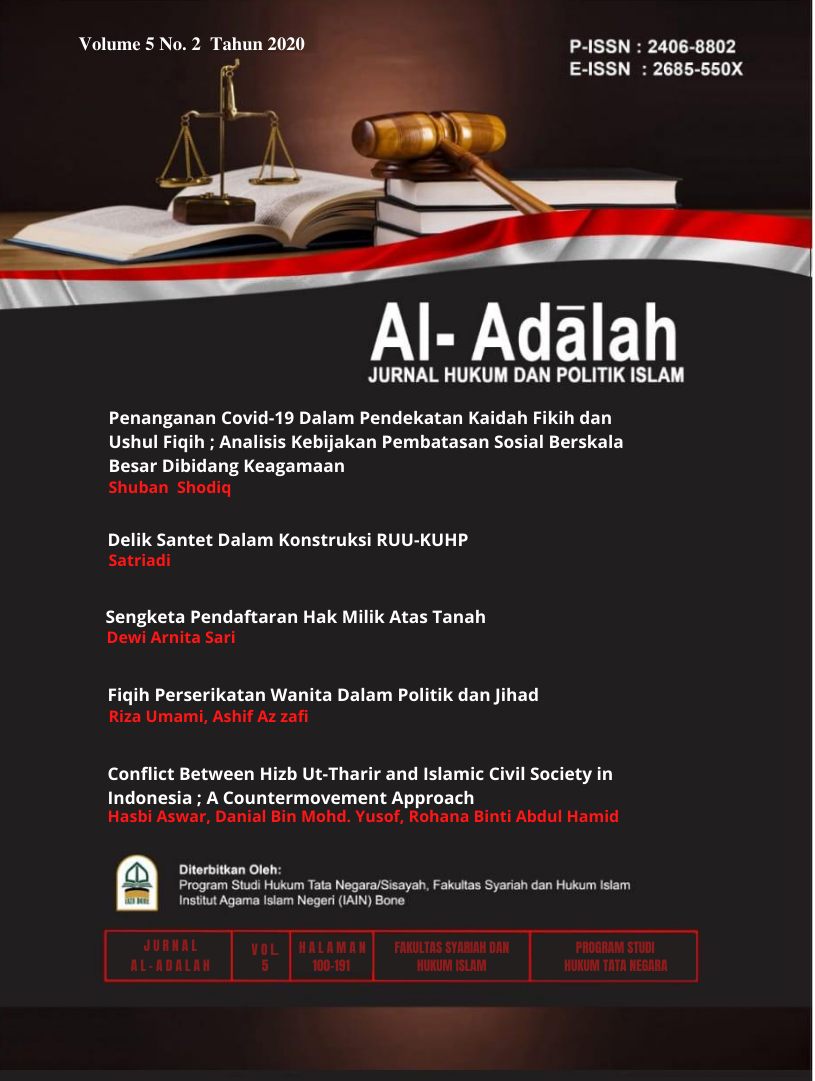
Penanganan Covid-19 Dalam Pendekatan Kaidah Fikih dan Ushul Fikih (Analisis Kebijakan Pembatasan Sosial Berskala Besar Dibidang Keagamaan)
DOI:
https://doi.org/10.35673/ajmpi.v5i2.743Keywords:
Covid-19, Pembatasan Sosial Berskala Besar (PSBB), Kaidah Fikih, Ushul FikihAbstract
The corona virus are sweeping the world. Transmission that is so fast from human to human causes heavy casualties. Based on research, this virus commonly spread through droplets and direct contact with sufferers. Nowadays, vaccines and drugs are still being developed by experts. Therefore, almost all country take on policies to prevent the spread of the virus. As an affected country, Indonesia also issued a policy of Pembatasan Sosial Sekala Besar (PSBB) (Large-Scale Social Restrictions). This rule regulate various aspects such as restrictions on educational, employment and worship activities. In the rules of worship, this regulation requires temporary abolition of worship in worship place. This instruction raises the pros and cons in society. Some people consider the omission of observance in the worship place is inappropriate due to the fact that other public places such as markets are still open. Using kaidah fikih and ushul fikih approach, this paper analyzes the policy. The results of this study indicate that the policy of eliminating the worship in the worship places during a pandemic is not inapposite with Islamic law. Moreover, to issue other policies in dealing with this pandemic, based on Islamic law, safeguarding lives (hifzh al-nafs) is prioritized more than protecting assets (hifzh al-mâl).
References
al-Bukhari, Muhammad bin Ismail, 2004, Shahîh Al-Bukâri. Dar al-Hadits, Kairo
al-Ghazali, Abu Hamid Muhammad. 2010, Al-Mustashfa Min ‘Ilm Ushûl. al-Maktabah al-Taufiqiyyah, Kairo
al-Haitami, Ahmad bin Muhammad. 2008, Al-Fath al-Mubîn Bisyarh al-Arba’în. Dar al-Minhaj, Jedah.
al-Ra’ini, Muhammad bin Muhammad. 2011, Qurrah Al-‘Ain Fî Syarh Waraqât Imâm al-Haramain. Dar al-Kutub al-Islamiyyah, Jakarta.
al-Suyuthi, Jalal al-Din Abdurrahman. 2011, Al-Asybâh Wa al-Nazhâir. Dar al-Fikr, Beirut.
al-Syairazi, Abi Ishaq Ibrahim bin Ali.2014, Al-Luma’ Fî Ushûl al-Fiqh. Beirut: Dar al-kutub al-’ilmiyyah, Beirut.
al-Syathibi, Ibrahim bin Musa. 2004, Al-Muwâfaqât. Dar al-kutub al-’ilmiyyah, Beirut.
al-Thabari, Muhammad bin Jarir. 2000, Tafsîr Al-Thabari. Muassasah al-Risalah, Beirut
Azam, Abdul Aziz. 2005 Al-Qawîd al-Fiqhiyyah. Dâr al-Hadits, Kairo
Aziza, Listiana, Adistikah Aqmarina, and Maulidiah Ihsan, eds. 2020, Pedoman Pencegahan Dan Pengendalian Coronavirus Disesase (Covid-19). Kementerian Kesehatan RI.Jakarta
Hamka. Tafsir Al-Azhar. 1982, Pustaka Nasional, Singapura.
Ibrahim, Duski. 2019, Al-Qawa`Id Al-Fiqhiyah (Kaidah-Kaidah Fiqih). Noerfikri, Palembang.
Isma’il bin Umar (Ibnu Katsir). 2011, Tafsîr Al-Qur’an al-‘Azîm. Dar al-Fikr, Beirut.
Lembaga Fatwa Dar al-Ifta Mesir. 2019, Dhawâbith Al-Ikhtiyâr al-Fiqhi ‘Inda al-Nawâzil. 2nd ed. Dar al-Ifta al-Mishriyyah, Kairo.
Muhammad bin Makram. 1414, Lisân Al-‘Arab. Beirut: Dâr Sâdir, Beirut.
Ridha, Rasyid. 1947, Tafsîr Al-Manâr. Dar al-Manar, Kaior.
Shawi, Ahmad bin Muhammad al-. 2016, Hâsyiah Al-Shâwi ‘Alâ Tafsîr al-Jalâlain. Dar al-kutub al-’ilmiyyah, Beirut.
Susilo, Adityo, Cleopas Martin Rumende, Ceva Wicaksono Pitoyo, Widayat Djoko Santoso, Mira Yulianti, Herikurniawan Herikurniawan, Robert Sinto, et al. “Coronavirus Disease 2019: Tinjauan Literatur Terkini.†Jurnal Penyakit Dalam Indonesia 7, no. 1 (April 1, 2020): 45. https://doi.org/10.7454/jpdi.v7i1.415.
Syarifuddin, Amir. 2014, Ushul Fiqh 1. Kencana, Jakarta.
Zaidan, Abdul Karim. 2006, Al-Wajîz Fî Usûl al-Fiqh. Muassasah al-Risâlah, Beirut.
Regulasi, Fatwa, dan Internet
Undang-Undang Republik Indonesia Nomor 6 Tahun 2018 Tentang Kekarantinaan Kesehatan (Lembaran Negara Republik Indonesia Tahun 2oi8 Nomor 128, Tambahan Lembaran Negara Republik Indonesia Nomor 6236).
Peraturan Pemerintah (PP) Republik Indonesia Nomor 21 Tahun 2020 Tentang Pembatasan Sosial Berskala Besar Dalam Rangka Percepatan Penanganan Corona Virus Disease 2019 (Covid-19)
Peraturan Gubernur (Pergub) Daerah Khusus Ibukota Jakarta Nomor 33 Tahun 2020 Tentang Pelaksanaan Pembatasan Sosial Berskala Besar Dalam Penanganan Corona Virus Disease 2019 (Covid-19) Di Provinsi Daerah Khusus Ibukota Jakarta
Fatwa Majelis Ulama Indonesia Nomor: 14 Tahun 2020 Tentang Penyelenggaran Ibadah Dalam Situasi Terjadi Wabah Covid-19
Hakim, Rakhmat Nur, "Menlu Retno: Presiden Sebut Ada 2 Perang, Melawan Covid-19 dan Pelemahan Ekonomi", https://nasional.kompas.com/read /2020/03/27/05345851/menlu-retno-presiden-sebut-ada-2-perang-me lawan-covid-19-dan-pelemahan. diakses pada 23 Mei 2020
https://www.who.int/emergencies/diseases/novel-coronavirus-2019/technical-gui dan ce/naming-the-coronavirus-disease-(covid-2019)-and-the-virus-that-ca uses-it. diakses pada 26 Mei 2020
https://www.worldometers.info/coronavirus/. diakses pada 27 Mei 20
Downloads
Published
How to Cite
Issue
Section
License
Authors who publish with Al-Adalah: Jurnal Hukum dan Politik Islam agree to the following terms:
Authors retain copyright and grant the journal right of first publication with the work simultaneously licensed under a Creative Commons Attribution License (CC BY-SA 4.0) that allows others to share the work with an acknowledgment of the work's authorship and initial publication in this journal.Â
Authors are able to enter into separate, additional contractual arrangements for the non-exclusive distribution of the journal's published version of the work (e.g., post it to an institutional repository or publish it in a book), with an acknowledgment of its initial publication in this journal.
Authors are permitted and encouraged to post their work online (e.g., in institutional repositories or on their website) prior to and during the submission process, as it can lead to productive exchanges, as well as earlier and greater citation of published work.