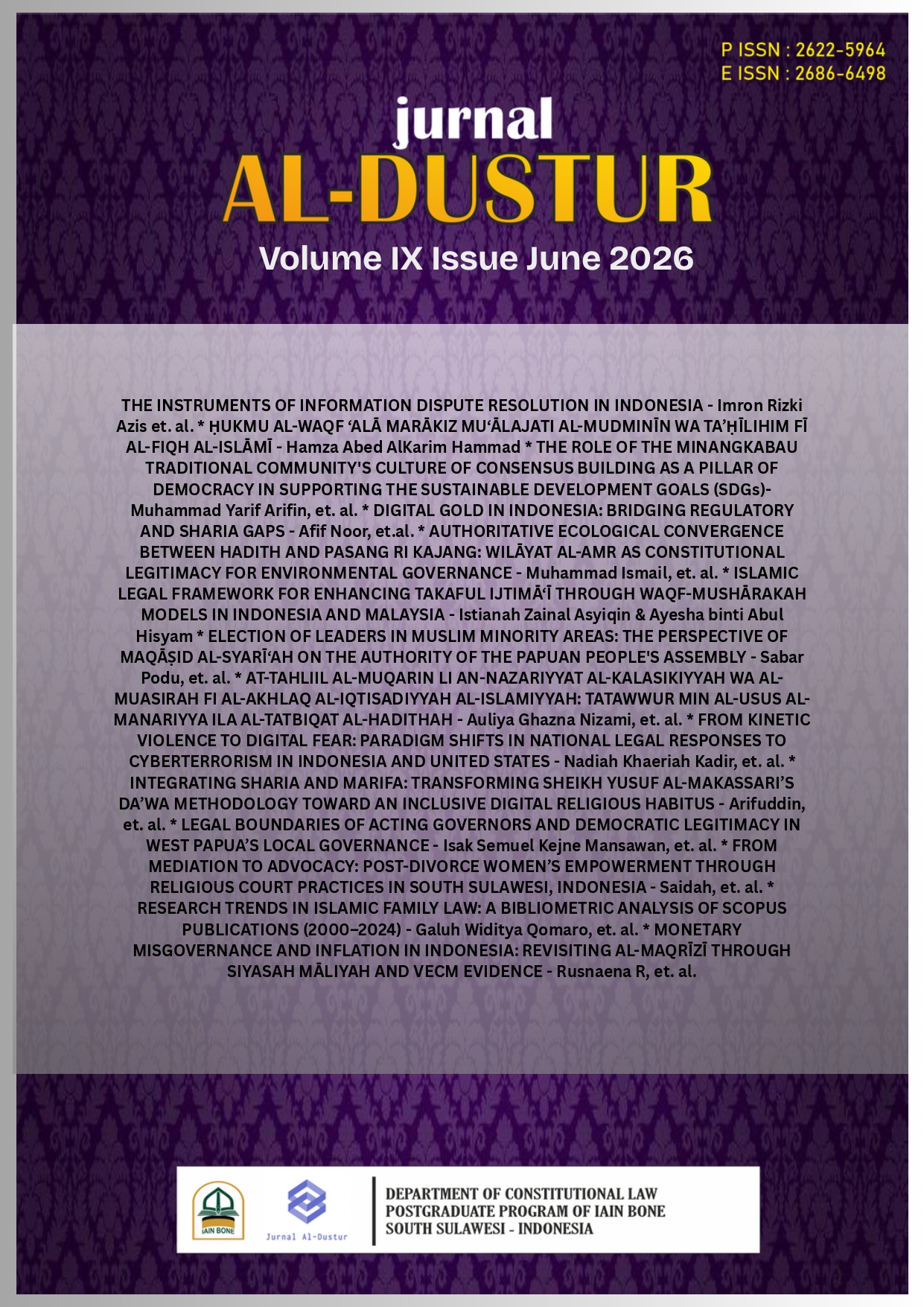
AUTHORITATIVE ECOLOGICAL CONVERGENCE BETWEEN HADITH AND PASANG RI KAJANG: WILĀYAT AL-AMR AS CONSTITUTIONAL LEGITIMACY FOR ENVIRONMENTAL GOVERNANCE
DOI:
https://doi.org/10.30863/aldustur.v9i1.11130Keywords:
Ecological Hadith, Wilāyat al-Amr, Environmental Governance, Legal Pluralism, Customary Environmental Law, Pasang ri Kajang.Abstract
This article examines the relationship between prophetic hadith and Pasang ri Kajang, the customary normative system of the Ammatoa Kajang community, through the framework of wilaayat al-amr in environmental governance. Situated at the intersection of hadith studies and Islamic constitutional thought, the study moves beyond textual interpretation to analyze how ecological hadiths function as sources of public authority in regulating collective environmental conduct. While previous scholarship has discussed Islamic environmental ethics and indigenous ecological traditions separately, their interaction as parallel normative authorities remains insufficiently explored. Using a qualitative normative-comparative method, this study analyzes selected ecological hadiths through dirāyah al-hadith, supported by maqashid al-shari‘ah and legal pluralism approaches. These findings are then compared with Pasang ri Kajang as a form of customary environmental law. The study finds that prophetic authority and Ammatoa customary leadership represent distinct yet functionally comparable forms of ecological governance. Prophetic authority operates universally, whereas Ammatoa authority functions locally as a socially autonomous institution that may also be recognized as a form of constitutional legitimacy within plural legal systems. This article argues that wilaayat al-amr should not be confined to formal state power alone, but may also include legitimate authority oriented toward public welfare (maslahah ‘ammah). By proposing the concept of authoritative ecological convergence, this study contributes to hadith studies, Islamic constitutional law, and environmental governance by offering a model through which religious norms and indigenous authority may coexist in promoting ecological sustainability. More broadly, the findings suggest that contemporary environmental policy should incorporate socially legitimate local authorities as strategic partners of the state in conservation governance. Such an approach may strengthen legal compliance, reduce jurisdictional conflict, and enhance the sustainability of environmental regulation.
References
Abdul Hamid, Ahmad Fauzi. “Islamic Governance, Ecology, and the Relevance of Siyāsah al-Bī’ah,” Al-Shajarah 27, no. 2. 2022.
Abdul Haris Sambu, Sejarah Kajang. Yogyakarta: Yayasan Pemerhati Sejarah Sulawesi Selatan Indonesia in collaboration with Lentera Kreasindo, 2016.
Abubakar, Yusuf Sani, Rajali Haji Aji, and Mpawenimana Abdallah Saidi. 2025. “The Principles of Natural Justice: A Comparative Analysis Between Secular and Islamic Law in Administrative Decision-Making”. Mazahibuna: Jurnal Perbandingan Mazhab, September, 176-92. https://doi.org/10.24252/mazahibuna.vi.56855.
Abu Daud, Sulayman ibn al-Ashath. Sunan Abi Dawud. Jilid 7. Kairo: Dar al-Risalah al-Alamiyyah, 2009
Adnan Hasan, Achmad Abubakar, and Muhammad Irham, “Integrating Maqasid al-Shariah into Islamic Sustainable Banking: A Systematic Review of Halal Industry Practices and Green Economy Alignment (2020–2024),” BANCO: Jurnal Manajemen dan Perbankan Syariah 8, no. 1.
Al-Bukhari, Muhammad bin Isma’il. Shahih al-Bukhari, Vol, 3. Dar Thauq al-Najah, 1422 H.
Al-Zuḥayli, Wahbah. Ushul al-Fiqh al-Islamy, vol. 2. Damascus: Dār al-Fikr, 1986.
Ammatoa and Galla Puto. Personal Interview. Conducted in Bulukumba, September 2023.
Andrew March, Islam and Liberal Citizenship. Oxford: Oxford University Press, 2009.
Anna M. Gade, “Islamic Environmental Ethics after Climate Crisis: Beyond Moral Theology,” Journal of Religious Ethics 49, no. 3. 2021.
Anna M. Gade, “Tradition, Authority, and the Development of Islamic Environmental Ethics,” Journal of the American Academy of Religion 82, no. 4. 2014.
An-Naʿim, Abdullahi Ahmed, Islam and the Secular State. Cambridge, MA: Harvard University Press, 2008.
Arun Agrawal, Environmentality: Technologies of Government and the Making of Subjects. Durham: Duke University Press, 2005.
Auda, Jasser. Maqasid al-Shariah as Philosophy of Islamic Law: A Systems Approach. London: IIIT, 2008.
Badewi, Etika Lingkungan dalam Budaya Ammatoa Kajang. Makassar: Pustaka Refleksi, 2018.
Benjamin J. Richardson, Local Climate Justice. Cheltenham: Edward Elgar, 2018.
Benton, Lauren. Law and Colonial Cultures. Cambridge: Cambridge University Press, 2002.
Boaventura de Sousa Santos, Toward a New Legal Common Sense. Cambridge: Cambridge University Press, 2002.
Brian Z. Tamanaha, “Legal Pluralism and Non-State Normative Orders in Contemporary Governance,” Journal of Legal Pluralism 53, no. 1. 2021
Brian Z. Tamanaha, A General Jurisprudence of Law and Society. Oxford: Oxford University Press, 2001.
Brown, Jonathan A. C. Hadith: Muhammad’s Legacy in the Medieval and Modern World . Oxford: Oneworld, 2017.
Brown, Jonathan A. C. Misquoting Muhammad: The Challenge and Choices of Interpreting the Prophet’s Legacy. Oxford: Oneworld, 2014.
Creswell, John W. Qualitative Inquiry and Research Design: Choosing among Five Approaches, 4th ed. Thousand Oaks, CA: Sage Publications, 2018.
Elfira et al., “Local Wisdom and Sustainable Ecology,” Asian Journal of Indigenous Studies 5, no. 2. 2023.
Elinor Ostrom, Governing the Commons. Cambridge: Cambridge University Press, 1990.
Fazlun Khalid, Islam and the Environment. London: Kube Publishing, 2019.
Fikret Berkes, Sacred Ecology, 3rd ed. New York: Routledge, 2012.
Frank Vogel, Islamic Law and Legal System. Leiden: Brill, 2000.
Franz von Benda-Beckmann et al., Mobile People, Mobile Law. Aldershot: Ashgate, 2005.
Franz von Benda-Beckmann, “Who’s Afraid of Legal Pluralism?” Journal of Legal Pluralism 47. 2002.
Hallaq, Wael B. Shari‘a: Theory, Practice, Transformations. Cambridge: Cambridge University Press, 2009.
Hallaq, Wael B. The Impossible State. New York: Columbia University Press, 2013.
Hallaq, Wael B. The Impossible State: Islam, Politics, and Modernity’s Moral Predicament. New York: Columbia University Press, 2013.
Hallaq, Wael B., Shari‘a: Theory, Practice, Transformations. Cambridge: Cambridge University Press, 2009.
Harald Motzki, “The Musannaf of ʿAbd al-Razzāq as a Source of Authentic Aḥādīth,” Journal of Near Eastern Studies 50, no. 1. 1991.
Hijjang, Ammatoa: Kepemimpinan Adat dan Kosmologi Lingkungan. Makassar: Ininnawa, 2015.
Ibn Al- Hajjaj, Muslim. Shahih Muslim, Vol. 1. Beirut: Dat Ihya’ al-Turath al-‘Araby, 1955.
Ibn Ashur, Muhammad al-Tahir. Maqasid al-Shari'ah al-Islamiyyah. Cairo: Dar al-Salam, 2006.
Ibn Hanbal, Ahmad. Musnad al-Imam Ahmad, vol. 20. Beirut: Muʾassasah al-Risalah, 2001.
Ibrahim Özdemir, “Islam, Ecology and Social Responsibility in the Anthropocene,” Worldviews 25, no. 2, 2021.
Ichwan et al., “Pasang ri Kajang and Environmental Ethics,” Journal of Local Wisdom 12, no. 1. 2021.
Istiawati, “Kearifan Lokal dan Pelestarian Lingkungan,” Jurnal Antropologi Indonesia 37, no. 2. 2016.
J. G. Ruggie, “Territoriality and Beyond,” International Organization 47, no. 1. 1993.
Jackson, Sherman A. Islam and the Blackamerican. Oxford: Oxford University Press, 2005.
Jackson, Sherman A. Islam and the Problem of Black Suffering. Oxford: Oxford University Press, 2009.
John Griffiths, “What Is Legal Pluralism?” Journal of Legal Pluralism 24. 1986.
Leopold Pospíšil, Anthropology of Law. New York: Harper & Row, 1971.
Mahkamah Konstitusi Republik Indonesia, Putusan No. 35/PUU-X/2012 tentang Pengujian Undang-Undang Nomor 41 Tahun 1999 tentang Kehutanan
Mark Van Hoecke, Methodologies of Legal Research. Oxford: Hart Publishing, 2011.
Michael Cook, Commanding Right and Forbidding Wrong in Islamic Thought. Cambridge: Cambridge University Press, 2000.
Mohammad Fadel, “Political Authority and Moral Agency in Islamic Law,” Journal of Law and Religion 26, no. 2. 2011.
Mohammad Hashim Kamali, “Environmental Governance and Public Interest in Islamic Law,” Islam and Civilisational Renewal 12, no. 4. 2021.
Mohammad Hashim Kamali, Principles of Islamic Jurisprudence. Cambridge: Islamic Texts Society, 2003.
Muhammad Adlin Sila, “Customary Authority and Indigenous Governance in Indonesia,” Indonesia and the Malay World 50, no. 146. 2022.
Nasr, Seyyed Hossein. Man and Nature: The Spiritual Crisis of Modern Man. Chicago: ABC International Group, 1997.
Neil Gunningham, “Environmental Law, Regulation and Governance,” Journal of Environmental Law 26, no. 2. 2014.
Norman K. Denzin and Yvonna S. Lincoln, The Sage Handbook of Qualitative Research, 5th ed. Thousand Oaks, CA: Sage Publications, 2018.
Odeh Rashed Al-Jayyousi, “Green Deen and Islamic Sustainability Ethics in the 21st Century,” Sustainability 13, no. 9. 2021.
Oran R. Young, Governing Complex Systems: Social Capital for the Anthropocene. Cambridge, MA: MIT Press, 2017.
Patrick Glenn, Legal Traditions of the World, 5th ed. Oxford: Oxford University Press, 2014.
Peter Fitzpatrick, The Mythology of Modern Law. London: Routledge, 1992.
Richard C. Foltz, “Is There an Islamic Environmentalism?” Worldviews: Global Religions, Culture, and Ecology 4, no. 1. 2000.
Sally Engle Merry, “Legal Pluralism,” Law & Society Review 22, no. 5. 1988.
Sally Falk Moore, Law as Process. London: Routledge, 1978.
Siddiq, Ahyar, and Asmuni Asmuni. 2025. “The Transformation of Judicial Ijtihad in the Indonesian Judiciary in Response to the Escalation of Law: A Maqasid Ash-Sharia Perspective”. Al-Mazaahib: Jurnal Perbandingan Hukum 13 (2): 122-49. https://doi.org/10.14421/al-mazaahib.v13i2.3945.
Tania Murray Li, The Will to Improve. Durham: Duke University Press, 2007.
Undang-Undang Dasar Negara Republik Indonesia Tahun 1945, Pasal 18B ayat (2)
United Nations Environment Programme, Global Environment Outlook 6. Cambridge: Cambridge University Press, 2019.
Ziauddin Sardar, “Reimagining Islamic Futures in the Age of Ecological Crisis,” Critical Muslim 39. 2021.
Downloads
Published
Issue
Section
License
Copyright (c) 2026 Muhammad Ismail, M Ali Rusdi, Muhammadiyah Amin, Zulfahmi Alwi, Sitti Asiqah Usman Ali

This work is licensed under a Creative Commons Attribution-ShareAlike 4.0 International License.
- Authors retain copyright and grant the journal right of first publication with the work simultaneously licensed under a Creative Commons Attribution-ShareAlike License (CC BY-SA 4.0) that allows others to share the work with an acknowledgement of the work's authorship and initial publication in this journal.
- Authors are able to enter into separate, additional contractual arrangements for the non-exclusive distribution of the journal's published version of the work (e.g., post it to an institutional repository or publish it in a book), with an acknowledgement of its initial publication in this journal.
- Authors are permitted and encouraged to post their work online (e.g., in institutional repositories or on their website) prior to and during the submission process, as it can lead to productive exchanges, as well as earlier and greater citation of published work.