
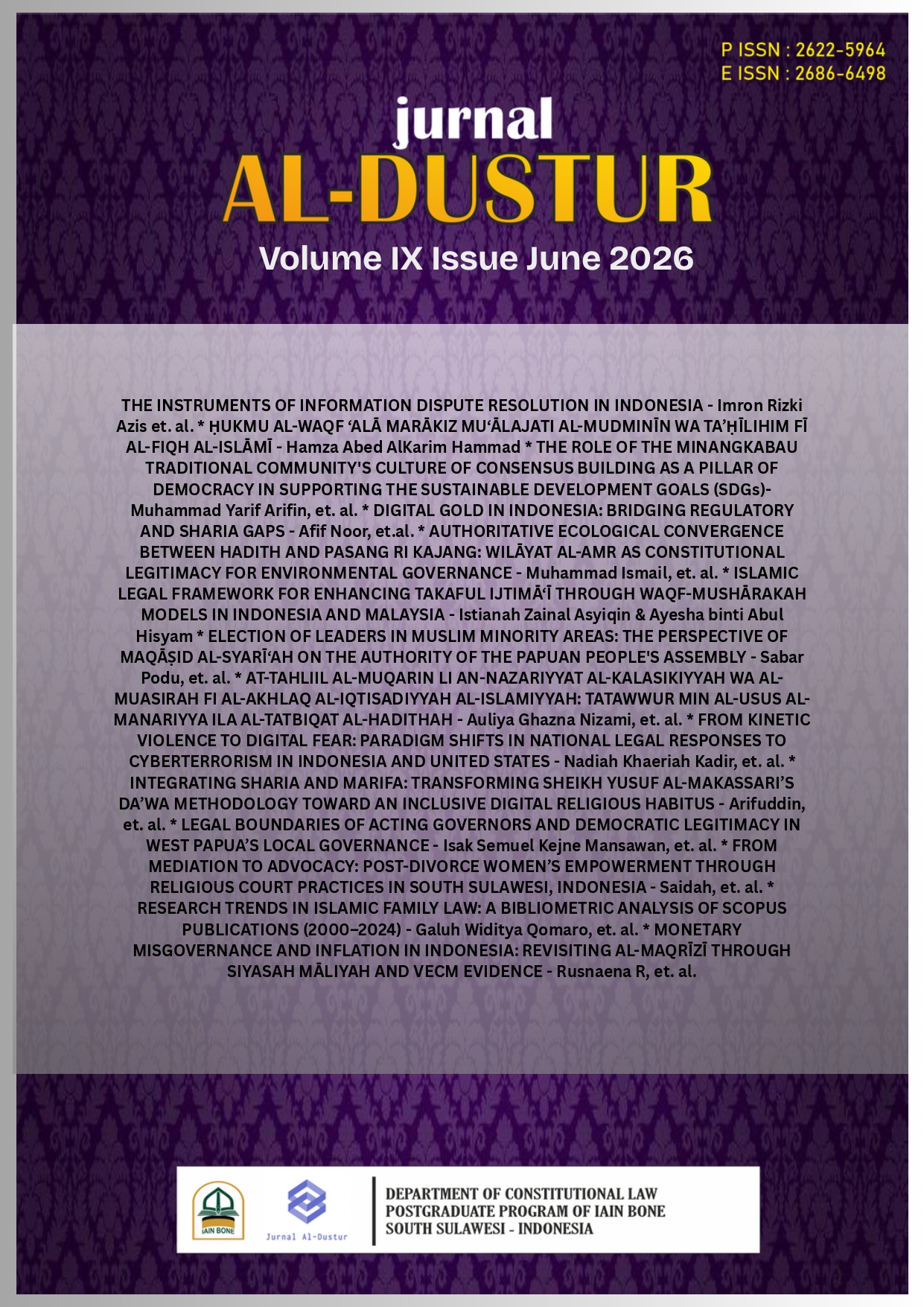
MONETARY MISGOVERNANCE AND INFLATION IN INDONESIA: REVISITING AL-MAQRĪZĪ THROUGH SIYASAH MĀLIYAH AND VECM EVIDENCE
DOI:
https://doi.org/10.30863/aldustur.v9i1.10919Keywords:
Inflation, al Maqrīzī, Siyasah Māliyah, Monetary Misgovernance, Governance Integrity, VECMAbstract
This article examines inflation in Indonesia as a problem of monetary misgovernance through the lens of al Maqrīzī’s siyasah māliyah. While inflation is commonly analyzed through money supply, exchange rate movement, and institutional quality, this study argues that these variables also reflect deeper ethical questions concerning monetary authority, fiscal accountability, and distributive justice. Using a sequential explanatory mixed method design, the study first applies a Vector Error Correction Model to quarterly Indonesian data from 2000 to 2024. The model examines the long term relationship between inflation, broad money supply, real exchange rate movement, and the Corruption Perception Index, here abbreviated as CPerI to avoid confusion with the Consumer Price Index. The findings show that a 1 percent increase in broad money supply raises inflation by 0.28 percent within three quarters, a 1 percent real exchange rate depreciation increases inflation by 0.19 percent, and a one point decline in CPerI increases inflation by 0.12 percent within two quarters. These quantitative findings are then interpreted through textual analysis of al Maqrīzī’s Ighāthat al Umma and expert interviews. The integrated analysis shows that al Maqrīzī’s critique of excessive fulūs circulation, currency debasement, and corrupt fiscal extraction corresponds to contemporary problems of irresponsible liquidity expansion, currency instability, and weakened governance integrity. The article contributes to Islamic public finance by developing an ethical institutional model of inflation, in which price instability is understood not only as a macroeconomic outcome, but also as a failure of amanah, wilayat al mal, and distributive justice.
References
Abdukadir, A. A. S., & Abdulle, A. Y. (2024). Nonlinear Effects of Inflation on Public Debt Sustainability in Somalia. International Journal of Sustainable Development and Planning, 19(8), 3201–3212. https://doi.org/10.18280/ijsdp.190832
Akbar, N., & Faizin, A. W. al. (n.d.-a). PROVING AL-MAQRIZIâ€TMS CONCEPT OF THE DETERMINANTS OF INFLATION: CROSS BORDER ANALYSIS. RePEc: Research Papers in Economics. Retrieved https://jimf-bi.org/index.php/JIMF/article/view/1142/790
Akbar, N., & Faizin, A. W. al. (n.d.-b). PROVING AL-MAQRIZIâ€TMS CONCEPT OF THE DETERMINANTS OF INFLATION: CROSS BORDER ANALYSIS. RePEc: Research Papers in Economics. Retrieved https://jimf-bi.org/index.php/JIMF/article/view/1142/790
Alreshaid, N. (2022). Special Economic Zones to Facilitate Trade and Investment Opportunities MENA Regional Applications amidst a Global Race to the Bottom. In Indonesian Journal of International and Comparative Law (Vol. 9, Number 1, pp. 43–100). https://www.scopus.com/inward/record.uri?partnerID=HzOxMe3b&scp=85132907297&origin=inward
Aswar, K., Ermawati, Jumansyah, Sumardjo, M., & Nopiyanti, A. (2022). The Role of Law Enforcement on Moderating the Relationship between Government Size, Fiscal Decentralization, Audit Finding and Corruption. Universal Journal of Accounting and Finance, 10(1). https://doi.org/10.13189/ujaf.2022.100122
Awaluddin, A. (2017a). INFLASI DALAM PRESPEKTIF ISLAM (ANALISIS TERHADAP PEMIKIRAN AL-MAQRIZI). JURIS (Jurnal Ilmiah Syariah), 16(2), 197. https://doi.org/10.31958/juris.v16i2.973
Awaluddin, A. (2017b). INFLASI DALAM PRESPEKTIF ISLAM (ANALISIS TERHADAP PEMIKIRAN AL-MAQRIZI). JURIS (Jurnal Ilmiah Syariah), 16(2). https://doi.org/10.31958/juris.v16i2.973
Budiono, I. N., Bakar, A. A., Haddade, H., Daily, S., & Husain, H. (2024). Integrating Local Culture to Work Ethics: A Holistic Approach to Mitigating Problematic Financing in Islamic Banks. BANCO: Jurnal Manajemen Dan Perbankan Syariah, 6(2). https://doi.org/10.35905/banco.v7i1.8784
Cahyo, E. N., Izaty, S. S., & Khusnia, A. K. (2025). FRIEDMAN’S MONETARY THEORY: A CRITICAL REVIEW BASED ON AL-MAQRIZI’S PERSPECTIVE. Iqtishaduna International Conference Proceeding, 1, 183–188. https://doi.org/10.54783/s3dg7639
Dusuki, A. W., & Abdullah, N. I. (2024). Maqasid al-Shari`ah, Maslahah, and Corporate Social Responsibility (2007). American Journal of Islam and Society, 41(1), 10–35. https://doi.org/10.35632/ajis.v41i1.3417
Fadilah, D., Rosyid, A., & Wartoyo, W. (2025). Kebijakan Fiskal Dan Moneter Dalam Ekonomi Islam Perspektif Pemikiran Al Maqrizi. Jurnal Inovasi Global, 3(7), 1040–1047. https://doi.org/10.58344/jig.v3i7.367
Fatkhurrozi, T., & Mugiyati. (2024). Efficiency and Accessibility of Sharia Home Financing for Millennials: A Study of BSI’s Griya Si Muda Program vs BTN iB Property. BANCO: Jurnal Manajemen Dan Perbankan Syariah, 6(2). https://doi.org/10.35905/banco.v6i2.9537
Firmansyah, H. (2021). Policy Model for Muslim State Inflation Control. International Journal of Nusantara Islam, 9(1), 93–105. https://doi.org/10.15575/ijni.v9i1.11984
Focacci, A., & Focacci, A. (2024). A Re-Appraisal of the Role of Monetary Policy: The Quantity Theory of Money through a Structural Vector Autoregressive Approach. Journal of Risk and Financial Management, 17(8), 355. https://doi.org/10.3390/jrfm17080355
Gao, L. (2022). Dynamic Quantity Theory of Money: Research on Monetary Cycle and Business Cycle Based on the Concepts of Issuing Money and Operating Money. Proceedings of Business and Economic Studies, 5(1). https://doi.org/10.26689/pbes.v5i1.3560
Hansen, B., & Friedman, M. (1957). Studies in the Quantity Theory of Money. Ekonomisk Tidskrift, 59(3). https://doi.org/10.2307/3438608
Harahap, S. M. (2023). Money and Inflation in Al-Maqrizi’s Islamic Economic Theory. Al-Masharif Jurnal Ilmu Ekonomi Dan Keislaman, 11(1), 1–12. https://doi.org/10.24952/masharif.v11i1.7660
Hassan, A. (2016). Islamic ethical responsibilities for business and sustainable development. Humanomics, 32(1). https://doi.org/10.1108/H-07-2015-0047
Krichene, N., & Ghassan, H. B. (2019). The pre‐eminence of gold and silver as Shariah money. Thunderbird International Business Review, 61(5), 821–835. https://doi.org/10.1002/tie.22040
Latif, A. W., & Syauqoti, R. (2023). Uang dan Inflasi Menurut Taqiyuddin Ahmad Al-Maqrizi (766-845 H/1364-1441 M). ULIL ALBAB : Jurnal Ilmiah Multidisiplin, 2(2).
Maghfiroh, D., & Rinaldy, R. (2020). Analisis Inflasi Saat Ini Menurut Imam Al Maqrizi. Co-Value : Jurnal Ekonomi, Koperasi, Dan Kewirausahaan, 11(3). https://doi.org/10.36418/covalue.v11i3.1270
Miar, M. (2025). Achieving wellbeing through economic growth and the role of social factors in sustainable development. Discover Sustainability, 6(1). https://doi.org/10.1007/s43621-025-01947-7
Muchsin, M. (2019). Historical development of tax during the early islamic period: Jizyah and Kharaj. Journal of Al-Tamaddun, 14(2), 1–7. https://doi.org/10.22452/JAT.vol14no2.1
Muhammad, I. (2021). The empirical evidence on taxpayers’ intention to claim zakat payment as a tax rebate. International Journal of Business and Society, 22(2), 637–652. https://doi.org/10.33736/ijbs.3748.2021
Nila Atikah, Akhmad Syafi’i, Upit Elya Rohimi, & Prieska Rani. (2023). Islamic Economic Position as a Breakfast to Reducing Inflation. Jurnal Multidisiplin Madani, 3(1). https://doi.org/10.55927/mudima.v3i1.2423
Ostrom, E. (2015). Governing the commons: The evolution of institutions for collective action. In Governing the Commons: The Evolution of Institutions for Collective Action. https://doi.org/10.1017/CBO9781316423936
Pramayanti, D. I., Janwari, Y., & Jubaedah, D. (2024). Monetary Theory According to Imam Al Maqrizi. International Journal of Law Social Sciences and Management, 1(4). https://doi.org/10.69726/ijlssm.v1i4.38
Pratiwi, F. D., Farhan, A., & Mulyono, R. D. A. P. (2023). Assessing Sharia Banking Commitment through the Shariah Maqashid Index. International Journal of Current Science Research and Review, 6(4), 2257–2264.
Rizqon, A. L., Prasetya, T. E., Ramadhan, M. U. C., & Habibah, S. (2022). Al-Maqrizi’s Inflation Concepts and Proof for the East Java Inflation Case 2015-2020. Al-Iktisab Journal of Islamic Economic Law, 6(1), 99. https://doi.org/10.21111/al-iktisab.v6i1.7608
Saharuddin, D., & Rama, A. (2017a). Currency System and Its Impact on Economic Stability. Al-Iqtishad Journal of Islamic Economics, 9(2). https://doi.org/10.15408/aiq.v9i2.4749
Saharuddin, D., & Rama, A. (2017b). Currency System and Its Impact on Economic Stability. Al-Iqtishad Journal of Islamic Economics, 9(2). https://doi.org/10.15408/aiq.v9i2.4749
Sahir, W. (2021). Relevance of al-ṡaman al-‘adl on Modern Transaction. Al-Kharaj: Journal of Islamic Economic and Business, 3(1). https://doi.org/10.24256/kharaj.v3i1.1416
Semenova, A. (2023). Rising temperatures and rising prices: the inflationary impacts of climate change and the need for degrowth-based solutions to the ecological crisis. Globalizations, 21(1), 103–120. https://doi.org/10.1080/14747731.2023.2222482
Setiawan, B., & Panduwangi, M. (2021). Measurement of Islamic banking attributes in Indonesia. … the Global Conference on Business …, (June).
Shibamoto, M. (2023a). Inflation, Business Cycle, and Monetary Policy: The Role of Inflationary Pressure. Discussion Paper Series.
Shibamoto, M. (2023b). Inflation, Business Cycle, and Monetary Policy: The Role of Inflationary Pressure. Discussion Paper Series.
Siregar, R. A., & Abdul Majid, M. S. (2022). Macro : Inflation And Economic Stability In Islam. International Journal of Science, Technology & Management, 3(5). https://doi.org/10.46729/ijstm.v3i5.592
SUNAL, O. (2018). CPI, MONEY SUPPLY AND EXCHANGE RATE DYNAMICS IN TURKEY: A VECM APPROACH. DergiPark (Istanbul University). https://dergipark.org.tr/tr/pub/jefa/issue/39466/465428
Ting, C. C. (2017). Quantity Theory of Money: True or False. International Journal of Economics and Finance, 9(10). https://doi.org/10.5539/ijef.v9n10p46
Umam, A. K. (2026). The The Concept of Al-Hisbah in Indonesia’s Modern Islamic Economy: Sharia Supervision in the Era of Blockchain and AI. Jesya (Jurnal Ekonomi & Ekonomi Syariah), 9(1), 262–273. https://doi.org/10.36778/jesya.v9i1.2552
Vatsa, P., & Mixon, F. G. (2022). Money, prices, and output: stylised facts and implications for the quantity theory of money. International Journal of Monetary Economics and Finance, 15(6). https://doi.org/10.1504/IJMEF.2022.10051970
Yusuf, M., Rahmadana, M. F., & Rizki, O. (2026). Exploring The Drivers of Inflation in Indonesia: A Quantitative Analysis. Science Publishing Corporation - International Journal of Accounting and Economics Studies, 13(2), 28–36. https://doi.org/10.14419/mkz47133
Zainal, M. K., & Zainal, M. K. (2020). INFLATION: LESSONS FROM AL-MAQRĪZĪ. TAFHIM IKIM Journal of Islam and the Contemporary World, 13(2), 85–113. https://doi.org/10.56389/tafhim.vol13no2.4
Downloads
Published
Issue
Section
License
Copyright (c) 2026 Rusnaena R, Muhammad Majdy Amiruddin, Umaima U, Nur Isma Padila

This work is licensed under a Creative Commons Attribution-ShareAlike 4.0 International License.
- Authors retain copyright and grant the journal right of first publication with the work simultaneously licensed under a Creative Commons Attribution-ShareAlike License (CC BY-SA 4.0) that allows others to share the work with an acknowledgement of the work's authorship and initial publication in this journal.
- Authors are able to enter into separate, additional contractual arrangements for the non-exclusive distribution of the journal's published version of the work (e.g., post it to an institutional repository or publish it in a book), with an acknowledgement of its initial publication in this journal.
- Authors are permitted and encouraged to post their work online (e.g., in institutional repositories or on their website) prior to and during the submission process, as it can lead to productive exchanges, as well as earlier and greater citation of published work.



