
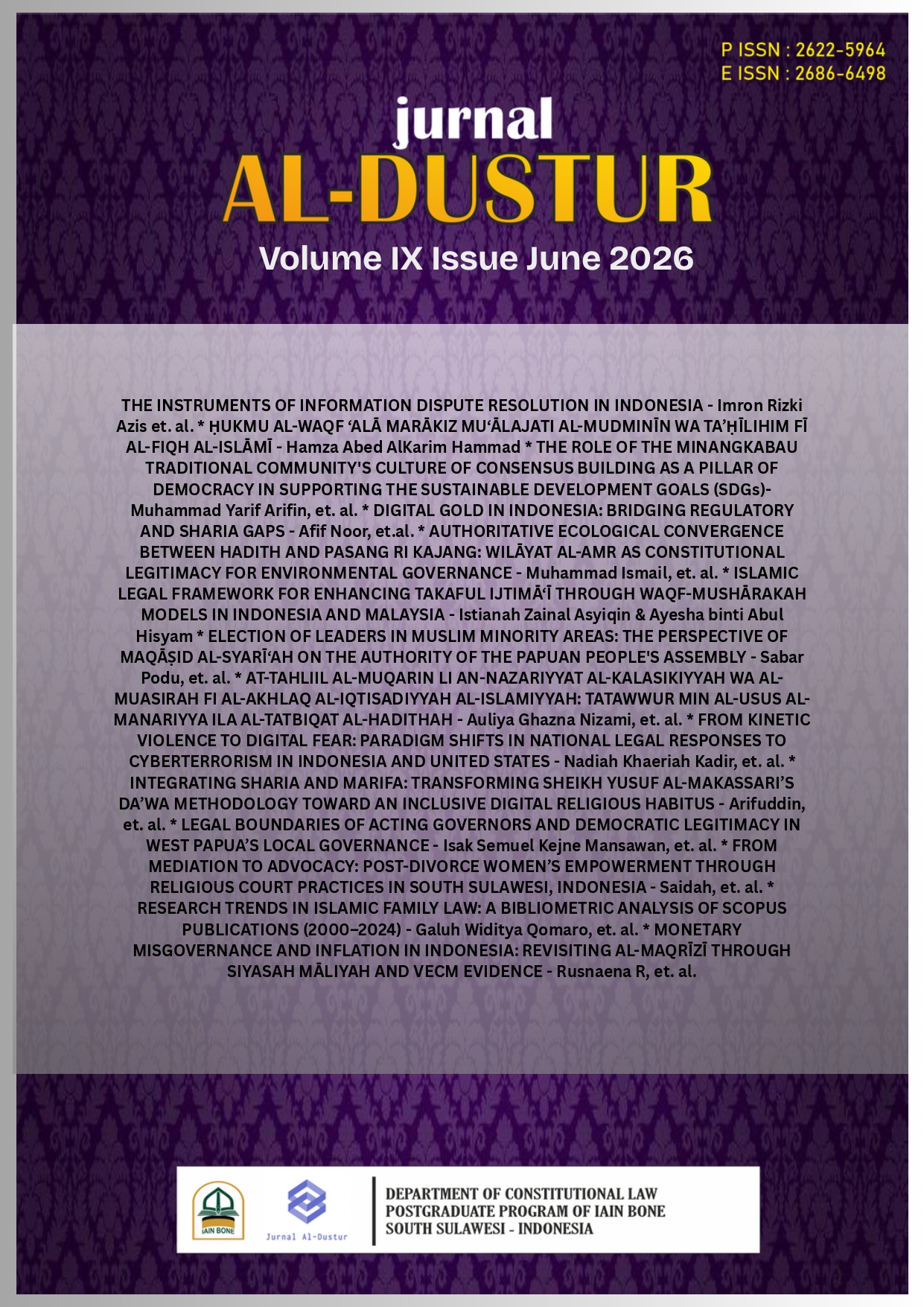
DIGITAL GOLD IN INDONESIA: BRIDGING REGULATORY AND SHARIA GAPS
DOI:
https://doi.org/10.30863/aldustur.v9i1.10646Keywords:
Digital gold, Islamic Investment, Regulation, Sharia Compliance, IndonesiaAbstract
This study examines the development of digital gold in Indonesia by analyzing regulatory gaps and Sharia compliance. The primary objective of this study is to assess the extent to which the current regulatory system aligns with Islamic law standards and to address legal ambiguities that impact both market participants and Muslim consumers. This study employs a qualitative approach, utilizing normative legal analysis and a literature review of financial regulations and fiqh mu‘āmalah principles related to digital gold. Official documents, regulations issued by the Financial Services Authority (OJK), and fatwas issued by Islamic legal institutions serve as data sources. The current regulatory framework lacks adequate integration with Sharia, leading to inconsistent legal practices and unclear standards. This regulatory ambiguity is evident in the status of digital gold as a commodity or financial instrument. Furthermore, the lack of uniform standards regarding gold ownership by selling platforms, storage mechanisms, and transparency of physical gold reserves adds to the uncertainty. In the context of fiqh mu‘āmalah, this violates Sharia principles such as riba (usury), gharar (gharar), bai' al-ma'dum (risk of betting), and maisir (gambling). Without clear regulations, digital gold can be problematic from both legal and Sharia-compliant perspectives. The research demonstrates the necessity to merge positive law with Islamic legal values to establish a legally valid digital gold system that is transparent and Sharia-compliant. The study proposes that regulators, industry stakeholders, and the Sharia Supervisory Board should collaborate to establish standardized practices and regulations. The development of adaptive Sharia-compliant digital gold regulations represents a strategic approach to promoting safe and sustainable growth in digital investment in Indonesia. The findings of this study provide a strong academic foundation for examining the effectiveness of Sharia regulations and governance in digital investment products, highlighting the importance of this research in the development of Islamic finance and digital investment.
References
AAOIFI. The AAOIFI Shari’ah Standard No. 57 on Gold and its Trading Crontols (2016).
Ahmed, Sundus Serhan. “The Evolving Role of Sustainable Development in Shaping Political Progress: A Contemporary Islamic Perspective on Human Rights and Civil Institution.” MILRev : Metro Islamic Law Review 4, no. 1 (2025): 1–30. https://doi.org/10.32332/milrev.v4i1.10128.
Andriyanto. “Emas Tersimpan, Finansial Aman: Menabung Emas Di Pegadaian Pilihan Cerdas Era Digital,” 2025.
Aidid, Muhammad Asri. 2024. “The Transformation of Interest Prohibition: A Comparative Study of Riba (Usury) in Contemporary Financial Systems”. Mazahibuna: Jurnal Perbandingan Mazhab, December, 113-127. https://doi.org/10.24252/mazahibuna.vi.44469.
Badan Pengawas Perdagangan Berjangka Komoditi Kementerian Perdagangan RI. “Bappebti Pastikan Pedagang Emas Digital Miliki Sedikitnya 10 Ribu Gram Emas Fisik Untuk Dapat Lakukan Transaksi,” 2024.
Bank Syari’ah Indonesia. “Dorong Inovasi Digital Dan Bisnis Emas, Laba BSI Triwulan I 2025 Tumbuh Double Digit,” 2025.
Baskoro, Ario Andika, and Yudho Taruno Muryanto. “Kewenangan Badan Pengawas Perdagangan Berjangka Komoditi Dalam Memberikan Perlindungan Hukum Bagi Korban Investasi Bodong Emas Digital ( Studi Kasus PT Tamasia Global Sharia ) Tinjauan Tentang Perlindungan Hukum.” TERANG : Jurnal Kajian Ilmu Sosial, Politik Dan Hukum 1, no. 1 (2024): 172–91. https://doi.org/0.62383/terang.v1i1.81.
Basnayake, Dananjani, Athula Naranpanawa, Saroja Selvanathan, and Jayatilleke S. Bandara. “Financial Inclusion through Digitalization and Economic Growth in Asia-Pacific Countries.” International Review of Financial Analysis 96, no. PA (2024): 103596. https://doi.org/10.1016/j.irfa.2024.103596.
Chang, Xinyi. “Gold Price Inflation and Its Implications for Financial Markets : Strategies for Mitigation.” In Proceedings of the 8th International Conference on Economic Management and Green Development DOI:, 0:189–94, 2024. https://doi.org/10.54254/2754-1169/119/20242530.
Dandapani, Krishnan. “E-Finance II.” Managerial Finance 43, no. 3 (2017): 352–67. https://doi.org/10.1108/MF-02-2017-0028.
Do, Minh Duc, Tho Dat Tran, Hong Nhung Nguyen, Ngoc Mai Le, and Duc Hieu Ninh. “Is Gold an Inflation Hedge in Vietnam? A Non-Linear Approach.” Cogent Economics and Finance 11, no. 2 (2023). https://doi.org/10.1080/23322039.2023.2244857.
Ericsson, Hans Gilbert. “Regulation in Preventing Fraud That Occurs Through Digital Physical Gold Trading by Integrating Technology and Human Approaches.” Asia Pacific Fraud Journal 8, no. 1 (2023): 183. https://doi.org/10.21532/apfjournal.v8i1.297.
Fidhayanti, Dwi, Mohd Shahid Mohd Noh, Ramadhita Ramadhita, and Syabbul Bachri. “Exploring The Legal Landscape of Islamic Fintech in Indonesia: A Comprehensive Analysis of Policies and Regulations.” F1000Research 13 (2024): 1–15. https://doi.org/10.12688/f1000research.143476.2.
Gaggar, Dharsana. “Electronic Gold Receipt: A Virtual Gold.” indiacorplaw.in, 2022.
Güney, Necmeddin. “Maqāsid Al-Sharī‘a in Islamic Finance: A Critical Analysis of Modern Discourses.” Religions 15, no. 1 (2024). https://doi.org/10.3390/rel15010114.
Hafis, Muhammad Haikal, and Mandra Lazuardi Kitri. “The Effect of Religiosity and Sharia Financial Literacy towards The Usage of Sharia Investments.” Proceeding Book of The 4th ICMEM 2019 and The 11th IICIES 2019, 7-9 August 2019, Bali, Indonesia, no. August (2019): 153–57.
Hamdan, Nur Hazirah Binti, Salina Binti Kassim, Nik Hadiyan Nik Azman, and Noor Amira Syazwani Binti Abd Rahman. “Consumers’ Behavioural Intention To Adopt Shari’Ah-Compliant Digital Gold Platform in Malaysia: Extension of Utaut Model.” Journal of Islamic Monetary Economics and Finance 11, no. 1 (2025): 35–62. https://doi.org/10.21098/jimf.v11i1.2035.
Heris Suhendar, Oyo Sunaryo Mukhlas, and Atang Abd. Hakim. “Legal Politics of the Existence of Fatwa in Islamic Financial Institutions: Evidence from Indonesia.” Jurnal Hukum Islam 21, no. 2 (2023): 279–308. https://doi.org/10.28918/jhi_v21i2_03.
Hidayat, Roni. “Sharia Review of Online Sale and Purchase of Gold on Antam Website.” ITQAN: Journal of Islamic Economics, Management, and Finance 4, no. 1 (2025): 76–85. https://doi.org/10.57053/itqan.v4i1.69.
Hidayati, Tri, Muhammad Syarif Hidayatullah, Parman Komarudin, and Atika Atika. “Digitalization of Islamic Finance: Epistemological Study of the National Sharia Board-Indonesian Council of Ulama’s Fatwa.” Al-Ahkam 33, no. 2 (2023): 255–78. https://doi.org/10.21580/ahkam.2023.33.2.17324.
Izmuddin, Iiz, Euis Amalia, Mohamad Abdun Nasir, and Farid Muttaqin. “The Legitimation of Religion in Profit Seeking: The Role of National Shari’ah Division of The Indonesian Muslim Council (DSN-MUI).” Samarah 7, no. 2 (2023): 781–800. https://doi.org/10.22373/sjhk.v7i2.15835.
Jisha, T P, and M Sumathy. “Digital Gold an Emerging Saving Opportunity : The Role of Digital Platform Familiarity on the Purchase Intention.” Wide Spectrum 13, no. 04 (2024): 16–27.
Juhro, Solikin M, Ferry Syarifuddin, Ali Sakti, Social-public Finance, and Monetary Economics. Inclusive Welfare On the Role of Islamic Social-Public Finance and Monetary Economics. Singapore: Springer, 2025. https://doi.org/10.1007/978-981-96-0051-9_2.
Khaerunnisa, Rizka. “BSI Catat Bisnis Emas Tumbuh 37,42 Persen per Mei 2024,” 2024.
Lamine, Ahlem. “G7 Investors Prefer Cryptocurrencies , Gold or Digital Gold to Hedge Their Risk ? Insights from Quantile Time Frequency Connectedness.” International Review of Economics and Finance 104, no. April (2025). https://doi.org/10.1016/j.iref.2025.104646.
Litvinenko, V. S. “Digital Economy as a Factor in the Technological Development of the Mineral Sector.” Natural Resources Research 29, no. 3 (2020): 1521–41. https://doi.org/10.1007/s11053-019-09568-4.
Mahmud, M D bin, M S Sudirman, and F Jufri. “The Influence of Islamic Financial Literacy on Behavior and Decisions to Invest in Gold Instruments.” Al-Tijary 9, no. 2 (2024): 133–48.
Mallya, Prathamesh. “Sebi’s New Framework on Gold: Here Are 5 Things to Know.” indiatimes.com, 2024.
Masyrafina, Idealisa. “Maraknya Kebocoran Data Di Indonesia, Hingga Masuk Skala Global.” fakta.com, 2024.
Muhammad, Mohd Zulkifli, Fatihah Mohd, Tamrin Amboala, Hanudin Amin, Wan Fatin Fatihah Yahya, Muhammad Khalilur Rahman, Azila Jaini, and Mohammad Salim Al-Rawashdeh. “Shariah-Compliant E-Payment Framework in Malaysia: Integrating Fiqh, Digital Security and Regulatory Governance.” Journal of Fatwa Management and Research 30, no. 2 (2025): 34–54. https://doi.org/10.33102/jfatwa.vol30no2.638.
Noor, Afif. “Socio-Legal Research: Integration of Normative and Empirical Juridical Research in Legal Research.” Jurnal Ilmiah Dunia Hukum 7, no. 2 (2023): 94–112.
———. “The Legal Regulatory Framework of Sharia Securities Crowdfunding in Indonesia.” Masalah-Masalah Hukum 51, no. 4 (2022): 433–44. https://doi.org/10.14710/mmh.51.4.2022.433-444.
Noor, Afif, Aqila-syarief Muhammad Afif, and Dwi Wulandari. “Legal Frameworks, Transparency, and Oversight: Ensuring Public Confidence in Online Donation Platforms.” Indonesian State Law Review 8 (2025): 184–204. https://doi.org/10.15294/islrev.v8i2.25429.
Noor, Afif, Moh Arifin, Deni Parama Widia Astuti, Maria Anna Muryani, Noor Rosyidah, Maliki Alfajr Davin Chandra Saputra, Dwi Wulandari, et al. “Revolutionizing Indonesia’s Financial Landscape: The Impact of Information Technology on the Growth of Financial Technology Start-Ups.” Multidisciplinary Reviews 6, no. 4 (2023). https://doi.org/10.31893/multirev.2023031.
Noor, Afif, Abdul Ghofur, and Anis Fittria. “Legal Protection in Sharia Securities-Based Crowdfunding : A Normative Review of Dual Regulation.” Al-Manāhij: Jurnal Kajian Hukum Islam 19, no. 2 (2025): 355–74. https://doi.org/10.24090/mnh.v19i2.14749.
Noor, Afif, Ali Maskur, Arifana Nur Kholiq, and Aisa Rurkinantia. “Maslahah -Based Protection of Fund Recipients in Fintech Lending Through Empowerment and Justice.” El-Mashlahah 15, no. 1 (2025): 1–20. https://doi.org/10.23971/el-mashlahah.v15i1.7786.
Noor, Afif, Ali Maskur, Dwi Wulandari, Aqila-Syarief Muhammad Afif, and Muhammad Fazli Azmi. Digital Economy Regulation and Consumer Rights Protection: Realizing Security in Financial Technology Transactions. Lex Scientia Law Review. Vol. 9, 2025. https://doi.org/10.15294/lslr.v9i2.24927.
Otoritas Jasa Keuangan RI dan Badan Pusat Statistik RI. “Survei Nasional Literasi Dan Inklusi Keuangan Tahun 2024.” Jakarta, 2024.
Pandey, Lata Kumari, Jayashree Bhattacharjee, Ranjit Singh, H Kent Baker, and Rohit Kumar Sharma. “Fintech Adoption and Dispositional Innovativeness in E-Gold Investment : Evidence from India.” Journal of Theoretical and Applied Electronic Commerce Research 20 (2025): 1–22. https://doi.org/10.3390/jtaer20020105.
Putri, Kadek Ratih Indriyani. “Perlindungan Konsumen Dalam Jual Beli Emas Melalui Platform Digital ‘ Tamasia .’” Acta Comitas 4, no. 3 (2019): 465–74.
Rahayu, Eva, and Raden Aswin Rahadi. “Exploring Investor Behavior and Decision Making in Alternative Investments.” International Journal of Current Science Research and Review 06, no. 07 (2023): 4180–88. https://doi.org/10.47191/ijcsrr/v6-i7-32.
Raimi, Lukman, Ibrahim Adeniyi Abdur-Rauf, and Saheed Afolabi Ashafa. “Does Islamic Sustainable Finance Support Sustainable Development Goals to Avert Financial Risk in the Management of Islamic Finance Products? A Critical Literature Review.” Journal of Risk and Financial Management 17, no. 6 (2024). https://doi.org/10.3390/jrfm17060236.
Renie, Elsy. “The Urgency of Fatwa in The Law of Sharia Economics in Indonesia.” Juris: Jurnal Ilmiah Syariah 20, no. 2 (2021): 201–8. https://doi.org/10.31958/juris.v20i2.4059.
Rifqiawan, Raden Arfan, Abdul Ghofur, Ali Murtadho, Supangat Supangat, and Zakeya Sanad. “Legal and Accounting Review of Sharia Fintech Financial Reports on Official Websites.” Al-Ahkam 35, no. 1 (2025): 59–86. https://doi.org/10.21580/ahkam.2025.35.1.23544.
Risman, Asep, Markonah Markonah, Jaih Mubarok, and Budi Lestijawan Eka Saputra. “Islamic Perspective of Gold-Based Investment: The Case of Indonesia.” Tazkia Islamic Finance and Business Review 18, no. 1 (2024): 1–17. https://doi.org/10.30993/tifbr.v18i1.363.
Safira, Nabila, Inayatillah, Rachmi Meutia, Nor ‘Azzah Kamri, and Ku Abdulmuhaimin Yusof. 2025. “Fintech Lending Adoption Among Muslim Millennials : Toward Inclusive and Ethical Sharia Banking in Southeast Asia”. BANCO: Jurnal Manajemen Dan Perbankan Syariah 7 (1):1-29. https://doi.org/10.35905/banco.v7i1.11358.
Sahira, Madhia Ramma. “Digital Digital Gold Pricing M Echanisms in DANA within Normative Legal Analysis.” Al-Risalah: Jurnal Ilmu Syariah Dan Hukum 26, no. 1 (2026).
Saputra, Ivan. “Gold Investment Choice for Gen Z in 2025.” In Proceeding of The International Conference on Business and Economics E-ISSN:, 2–5, 2025. https://doi.org/10.56444/icbe-untagsmg.v3i1.2699.
Setyowati, Desi. “Hampir 160 Juta Data Di Indonesia Bocor, Terbanyak Ke-13 Dunia.” katadata.co.id, 2024.
Shaikh, Abdul, Naresh Adhikari, Amril Nazir, Abdul Salam Shah, Saranjam Baig, and Hafedh Al Shihi. “Blockchain-Enhanced Electoral Integrity : A Robust Model for Secure Digital Voting Systems in Oman.” F1000Research, no. May (2025): 1–35. https://doi.org/10.12688/f1000research.160087.
Sholeh, M. Asrorun Niam, Muhammad Fauzinudin Faiz, and Moh Muhlis Anwar. “A Critical Analysis of Islamic Law and Fatwa of MUI (Majlies Ulama Indonesia) & NU (Nahdlatul Ulama’) on A Gold-Backed Cryptocurrency (OneGram).” Al-Ihkam: Jurnal Hukum Dan Pranata Sosial 17, no. 2 (2022): 506–30. https://doi.org/10.19105/al-Ihkam.v17i2.6511.
Som, Ankit, and Parthajit Kayal. “Blockchain : Research and Applications A Multicountry Comparison of Cryptocurrency vs Gold : Portfolio Optimization through Generalized Simulated Annealing.” Blockchain: Research and Applications 3, no. March (2022). https://doi.org/10.1016/j.bcra.2022.100075.
Suaidi. “Bridging Institutional and Regulatory Gaps: Enhancing Sharia Compliance in Islamic Financial Institutions in Indonesia.” El-Uqud: Jurnal Kajian Hukum Ekonomi Syariah 3, no. 1 (2025): 23–39. https://doi.org/10.24090/eluqud.v3i1.13288.
Subathara, S. “Investment In Digital Gold : A Financial And Behavioral Perspective.” International Journal of Creative Research Thoughts 13, no. 9 (2025).
Sukananda, Satria. “Pendekatan Teori Hukum Progresif Dalam Menjawab Permasalahan Kesejangan Hukum (Legal Gaps) Di Indonesia.” Jurnal Hukum Ekonomi Syariah 1, no. 2 (2018): 135. https://doi.org/10.30595/jhes.v1i2.3924.
Suryani, Irma, Mohamad Hidayat Muhtar, Yogi Muhammad Rahman, Belardo Prasetya Mega Jaya, and Awad Al Khalaf. “Integration of Islamic Law in Regional Development in Indonesia.” Juris: Jurnal Ilmiah Syariah 22, no. 1 (2023): 1–11. https://doi.org/10.31958/juris.v22i1.8770.
Tritto, Angela, Yujia He, and Victoria Amanda Junaedi. “Governing the Gold Rush into Emerging Markets: A Case Study of Indonesia’s Regulatory Responses to the Expansion of Chinese-Backed Online P2P Lending.” Financial Innovation 6, no. 1 (2020). https://doi.org/10.1186/s40854-020-00202-4.
Wang, Shumin, Yincheng Li, and Muhammad Bilawal Khaskheli. “Innovation Helps with Sustainable Business, Law, and Digital Technologies: Economic Development and Dispute Resolution.” Sustainability (Switzerland) 16, no. 10 (2024): 1–18. https://doi.org/10.3390/su16103910.
Wati, Lina, and Rama Dani. “The Prospects of Digital Gold Investment Among Generation Z : A Perception Analysis Based on a Modified UTAUT Model.” Journal of Innovative and Creativity 6, no. 1 (2026): 12676–87.
Widjaja, Michaelia, Gaby, and Shinta Amalina Hazrati Havidz. “Are Gold and Cryptocurrency a Safe Haven for Stocks and Bonds? Conventional vs Islamic Markets during the COVID-19 Pandemic.” European Journal of Management and Business Economics 33, no. 1 (2024): 96–115. https://doi.org/10.1108/EJMBE-05-2022-0135.
Wijayanti, Rita, and Doddy Setiawan. “The Role of the Board of Directors and the Sharia Supervisory Board on Sustainability Reports.” Journal of Open Innovation: Technology, Market, and Complexity 9, no. 3 (2023): 100083. https://doi.org/10.1016/j.joitmc.2023.100083.
Yahaya, Mohammad Zaini. “Constructive Possession in the Sale and Purchase of Gold According to Changes in the Customary Practice.” Samarah 7, no. 3 (2023): 1317–32. https://doi.org/10.22373/sjhk.v7i3.16025.
Yang, Pan, Naixue Xiong, and Jingli Ren. “Data Security and Privacy Protection for Cloud Storage: A Survey.” IEEE Access 8 (2020): 131723–40. https://doi.org/10.1109/ACCESS.2020.3009876.
Downloads
Published
Issue
Section
License
Copyright (c) 2026 Afif Noor, Supangat, Aqila-Syarief Muhammad Afif, Muhammad Fazli Azmi

This work is licensed under a Creative Commons Attribution-ShareAlike 4.0 International License.
- Authors retain copyright and grant the journal right of first publication with the work simultaneously licensed under a Creative Commons Attribution-ShareAlike License (CC BY-SA 4.0) that allows others to share the work with an acknowledgement of the work's authorship and initial publication in this journal.
- Authors are able to enter into separate, additional contractual arrangements for the non-exclusive distribution of the journal's published version of the work (e.g., post it to an institutional repository or publish it in a book), with an acknowledgement of its initial publication in this journal.
- Authors are permitted and encouraged to post their work online (e.g., in institutional repositories or on their website) prior to and during the submission process, as it can lead to productive exchanges, as well as earlier and greater citation of published work.



